

ANTISEMITISM in CHURCH HISTORY
Part 2 in the series Antisemitism throughout History. Read Part 1 Here
New Resource
Tensions existed from the outset between early Christians and the Jewish religious leaders. Though Christianity was a distinctly Jewish movement, persecution soon arose against the new teaching (Acts 4-5) turning violent with the stoning of Stephen (Acts 6-7) and Saul’s zealous imprisonment of believers (Acts 8:1-3; 9:1-2). Due in part to this persecution, Christianity soon spread beyond Jewish communities, resulting in many Gentile conversions. In turn, the widening gap between these two Jewish faiths progressively led early “Church Fathers” to advocate for a clear distinction between them. In less than 150 years, this distinction morphed into a rejection of both Judaism and the Jews themselves as the chosen people of God. Christian antisemitism had begun.
Between 155 and 160 AD, Justin Martyr wrote Dialogue with Trypho the Jew, in which he claimed that all God’s blessings to the Jews had now passed to the church, which he described as “the new Israel.” This is one of the earliest references to what is now known as “Replacement Theology.” He also alleged that Jews repeatedly persecuted Christians. Tertullian (writing around 197-212 AD) taught that ALL Jews were guilty of rejecting and killing Christ and thus deserved God’s judgement and replacement by the Church. Implicit in these assertions are two significant extra-biblical ideas: 1. Jews are no longer God’s chosen people; 2. Jews are the enemies of the Church.
When Emperor Constantine came to faith in 312 AD and subsequently legalised Christianity (Edict of Milan in 313 AD), it became the favoured religion of the Empire. The Council of Nicaea (325 AD) then officially separated the Church from Jewish practices, rejected the Jewish calendar, and endorsed Sunday worship in place of the Jewish Sabbath. The gap with the Jews was expanding!
Towards the end of the 4th Century, John Chrysostom (writing in 387 AD) in a sermon-series titled, “Against The Jews,” called them, “slayers of Christ,” whose synagogues were a dwelling for demons and places of idolatry. In order to dissuade Christians from any attraction to their teachings or practices, he instructed his congregation to “hate the Jews.” Commentators suggest these words may reflect hyperbolic language of the era but, as Jewish scholar, Steven Katz, observed (in 2023), these charges demonstrated a “decisive turn in the history of Christian anti-Judaism,” and later, in the Nazi era, were used to fuel hatred towards the Jews.
In the 5th Century, the renowned theologian, Augustine of Hippo (c 354-430 AD), reinforced the belief that ALL Jews were responsible for the murder of Jesus and doomed forever to exile and subordination. With such pronouncements from influential theologians of the early Church, we should not be surprised by the centuries of antisemitic teaching and rejection that followed.
NT accounts were also invoked to negatively shape perceptions of the Jews. In an article titled, The Historical Roots of Antisemitism, Jonathan Judaken, writes: “First was the depiction of Judas, the traitor willing to sell out God for 30 pieces of silver. Second, was the portrait of Caiaphas and other Jewish leaders who were concerned only with their own power. Third, was the claim the Jews were “Christ killers,” derived from the scene…where the Jews called upon the Roman Governor Pontius Pilate to crucify Jesus… (insisting)… “His blood be upon us and upon our children.” Fourth, was the association of Jews with Satan… when Jesus says to a group of pharisees, “You are of your father the devil, and your will is to do your father's desires.” Lastly, is the supersessionist claim - the doctrine that the new covenant through Jesus supersedes the old covenant with the Jewish people - which crowned Jesus’ followers as the new Israel, bestowing upon them the promises given by God to the Jews, and projecting onto the forsaken Jews the curses of those accursed by the divine.” Over the next few centuries, this unfavourable perception was perpetuated through sermons, church services, passion plays, and European folklore.
By the time of Charlemagne (c 742-814 AD), Christianity was the dominant religion of Europe and Jews were banned from owning land, coerced to convert to Christianity and allowed only restricted rights. These policies paved the way for the Crusades, expulsions, pogroms, and antisemitic atrocities of subsequent centuries.
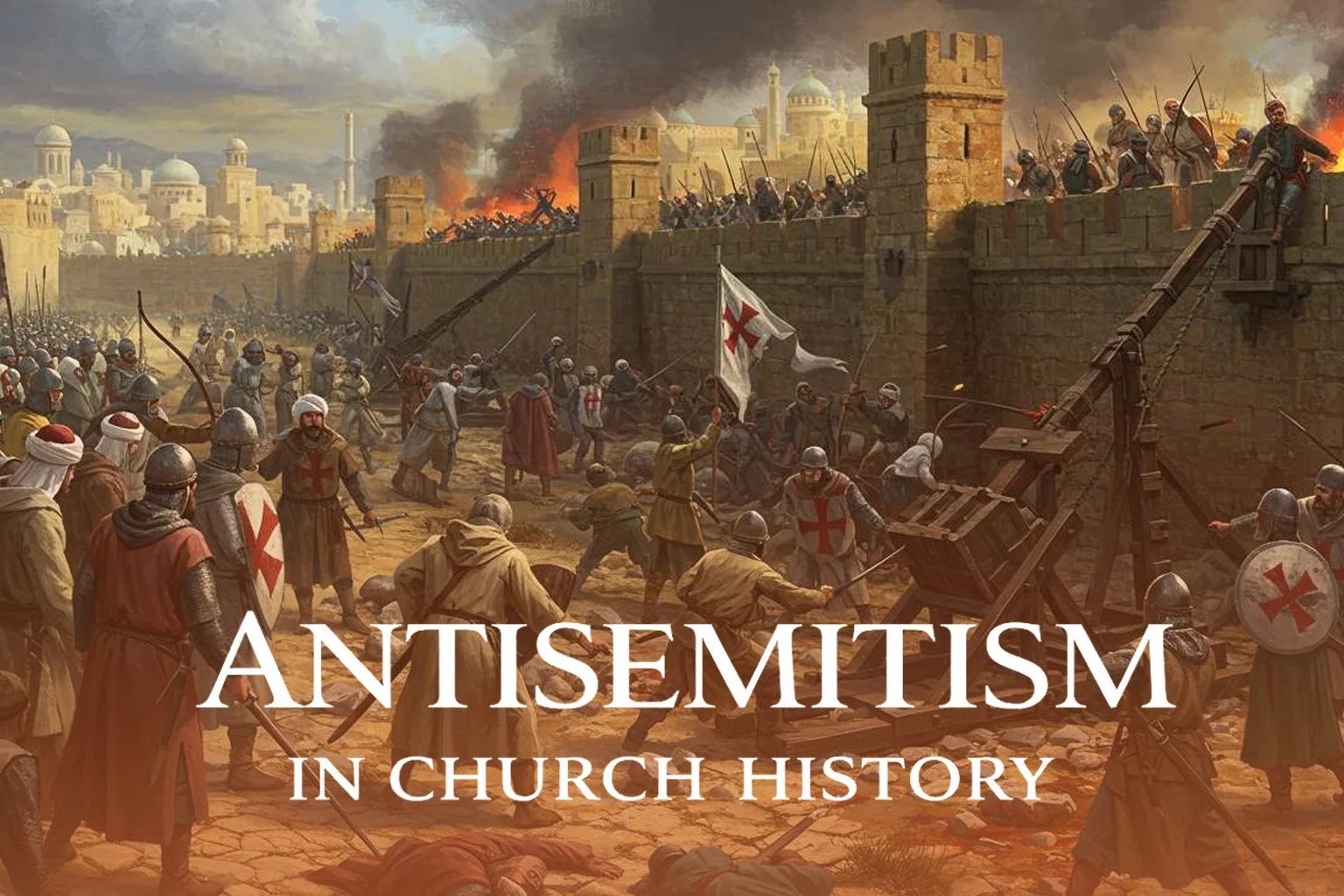
In 1096, Pope Urban II sent the 1st Crusade to liberate Christian Holy sites. On the way, “Jewish Infidels” living in Christian territories, especially in the Rhine and Danube valleys, were slaughtered and pillaged. In The Holy Land itself, thousands more Jews were killed. This anti-Jewish hatred continued around 200 years. The Cross was prominently displayed on the armour of the crusaders and to this day, some Jewish people see the cross as a symbol of hatred and oppression by Christians.
Following the Crusades came accusations of Blood Libels where, supposedly, Jews ritually murdered Christians (particularly children) to use their blood for Passover Matzo. This claim emerged in Europe in the 12th Century and has continued to this day. Throughout Europe, Jews often faced the threat of violence: they were massacred in York in 1190, expelled from England a century later, removed from France in 1306, and forced out of Spain in 1492 after the brutal Spanish Inquisition.
With the rise of the great cathedrals of Europe, antisemitic depictions were literally built into the stone and glass elements of the buildings. One example can still be seen at the medieval Strasbourg Cathedral (built in 1439) with two statues near the entrance depicting Ecclesia and Synagoga representing the Church crowned triumphant and Judaism blindfolded, its authority broken and its role superseded. The Great Famine (1315-1317), followed by the Bubonic Plague which killed an estimated 1/3 of all Europeans, was also falsely rumoured to be Jewish plots to destroy Christendom.
In 1543, Martin Luther, who initially tolerated Jews, now turned against them. In his book, The Jews and Their Lies, Luther suggested: “set fire to their synagogues or schools”; “their houses… be razed and destroyed”; “ all their prayer books and Talmudic writings… be taken”; “their rabbis be forbidden to teach…on pain of loss of life and limb”; “safe-conduct on the highways be abolished completely for the Jews.” It is hard to reconcile such vitriol from one so otherwise used of God. These teachings were subsequently used by the Nazis as part of their justification for the Holocaust!
It is not in the scope of this writing to deal with historical antisemitism apart from Christianity, but mention must be made of “Protocols of the Elders of Zion”(1903), a fabrication by the Russian secret police which became a blueprint for anti-Jewish conspiracy theories. It purports to be the minutes of secret meetings of Jews plotting to control the world. While it has been exposed as a forgery, it was used by the Nazis to blame Jews for Germany’s problems after WW2, by Muslims denouncing Zionism as the source all their problems, by HAMAS who quote it in their charter, and shamefully, by Christians who have believed the lie even in our day!
As today’s Christians, we cannot change the errors of the past. But God is not finished with the Jews, and they are central to His future prophetic plans and purposes. We must stand against Antisemitism in all its forms and uphold the truth of God’s Word.

By Dr. Michael Rydelnik
DESCRIPTION
Understand Israel through Scripture—not the headlines.
As Israel and the Jewish people dominate headlines, from war and terrorism to rising antisemitism, many believers are asking important questions. What is the relationship between modern Israel and the Bible? Do the Jewish people still have a role in God’s plan? And how should the church respond?
In How Should Christians Think About Israel?, Dr. Michael Rydelnik answers these questions with a clear, biblical perspective—not a political one. Drawing from decades of study and teaching, he guides readers through Scripture to understand Israel’s unique identity and enduring significance in God’s redemptive plan.
Paperback, 128 pages.
Code: BP095