

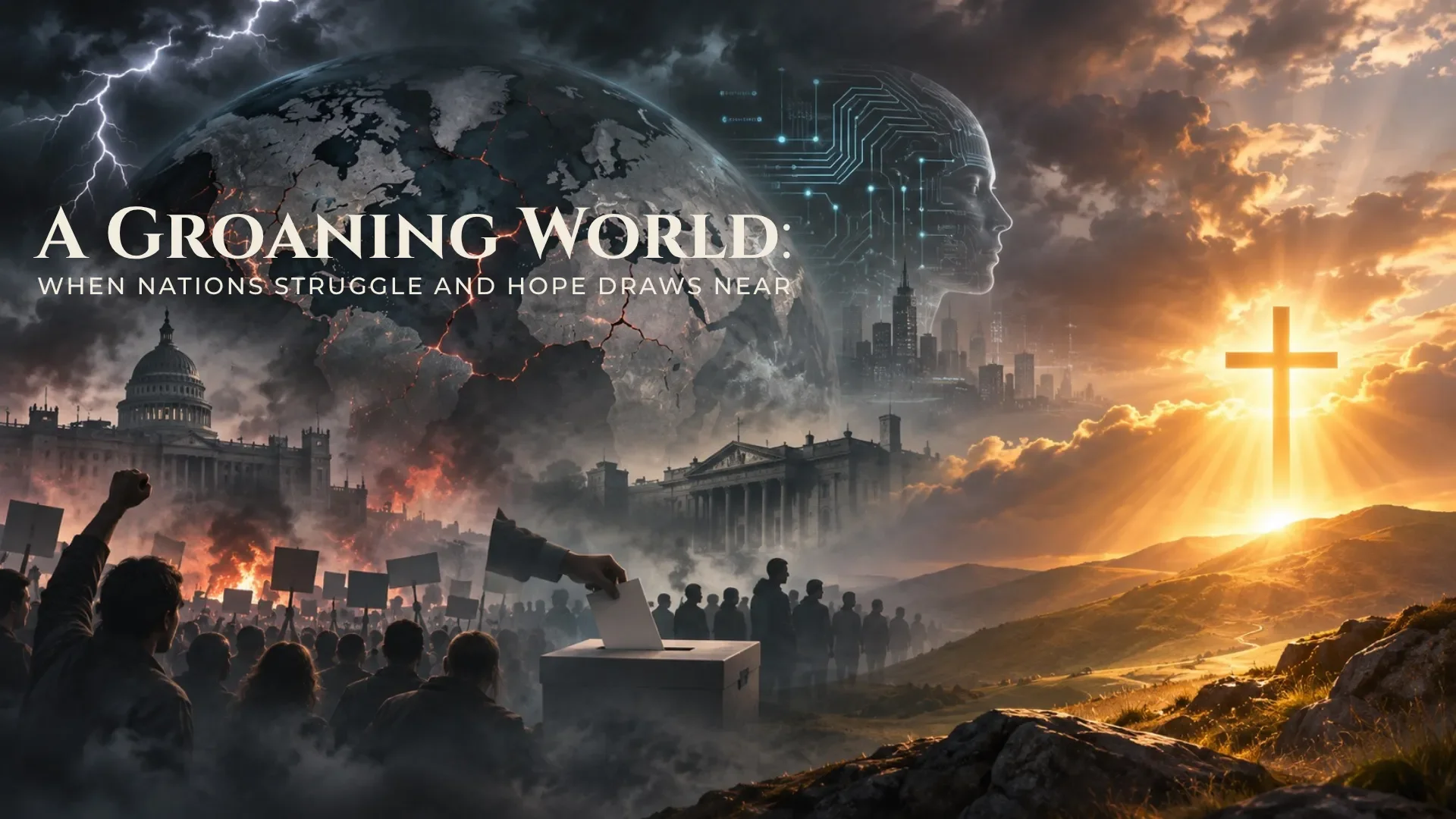
November 2026 | A biblical perspective on a world that is increasingly hard to govern
I'll be honest with you: lately I've found it harder to read/watch the news without it causing heaviness in my heart. Political instability, social division, rising violence and technology that changes faster than we can understand it are reshaping the societies many of us once thought were relatively stable and secure. Governments struggle to govern, communities pull in opposite directions, and the very idea of truth and morality is being fought over.
As a Christian, I find these things troubling, but I can't say they surprise me.
Paul wrote that "the whole creation groans and labours with birth pangs together until now" (Romans 8:22, NKJV). I can think of no better description of the world we're living in: a creation suffering under the weight of sin, and for those who believe, waiting for the redemption God has promised.
A World Groaning Under Sin
We see it across Europe, where civil unrest, violent demonstrations and political upheaval have exposed deep divisions over immigration, national identity, religion and cultural values. Antisemitism continues to threaten Jewish communities, and anger and hatred increasingly shape our public conversation.
What strikes me most is that our political disagreements are rarely just about policy any more. Underneath them are very different convictions about what is true, what is right, what freedom means and what it means to be human. It also seems as though rational, logical and civil discourse has evaporated.
Jesus, speaking in the context of future tribulation warned that "because lawlessness will abound, the love of many will grow cold" (Matthew 24:12). Paul told Timothy that a time would come when people would turn away from sound doctrine and gather teachers who say what they want to hear (2 Timothy 4:3–4), and he wrote with deep sorrow of a time to come when those refusing the truth will become open to powerful deception (2 Thessalonians 2:10–12).
While we are not in the Tribulation, the momentum of change feels faster than we would like or expected. As it was in the events of history, change can occur quickly even in a world far removed from conflict, like an earthquake the seismic effects are felt globally.
Then there is artificial intelligence. I'm genuinely amazed by what it promises for medicine, productivity and communication. Yet it also raises hard questions about jobs, identity, surveillance, misinformation and the manipulation of truth. It is rare for humanity to build something whose long-term effects even its own creators can't fully predict. The last time we faced anything like it was probably the arrival of nuclear weapons.
However, the question is not so much what humanity can build, but whether there is sufficient collective moral wisdom to govern what we build. The evidence of this is not terribly encouraging.
Remembrance Day: The Sobering Lessons of History
It has been 108 years since the guns fell silent on the Western Front at 11 am on 11 November 1918, and I find it sobering to stop and think about what that moment cost. The First World War claimed millions of lives and devastated a generation. More than 60,000 Australians died, and countless families and communities were changed for ever.
Yet the peace that followed proved painfully fragile. Barely two decades later the world was at war again. The Second World War claimed an estimated 70+ millions lives, including six million Jews who were systematically murdered in the Holocaust and remains the deadliest conflict in history.
Two world wars within a single generation showed us how terrible humanity's capacity for destruction is, and how quickly peace can unravel.
As we remember those who sacrificed so much, I think we should reflect on what history teaches. Despite remarkable advances in education, diplomacy, international institutions and technology, we have never managed to remove the roots of hatred, greed, division and war.
The prophet Jeremiah wrote, "The heart is deceitful above all things, and desperately wicked" (Jeremiah 17:9).
Remembrance Day speaks not only of the terrible cost of war, but also the need for redemption. We honour those who gave their lives in the cause of peace, however as we again watch peace unraveling we can only trust that lasting peace will ultimately come through the Prince of Peace Himself (Isaiah 9:6).
Elections, Division and the Difficulty of Governing
The past two weeks have given us three striking pictures of how divided Western democracies have become.
United States: A President Facing a New Congress
In the November 3rd midterms, American voters handed Democrats control of both the House of Representatives and the Senate, ending Republican control of Congress. Democrats flipped seven Republican-held Senate seats and will hold at least 54 seats in the chamber. In the House they flipped more than 30 seats, with their total already past 240 while the final counts are completed.
President Trump keeps the presidency and the power of the veto, but a Democratic Congress will make it much harder to pass his agenda, will bring far more oversight, and will give Democrats a bigger say over appointments that need Senate approval. With two years of his term remaining, major legislation will need compromise between sharply divided sides, and where compromise fails we may see gridlock.
Of course the big question is whether Trump will remain a strong friend and ally to Israel. Having announced unceremoniously a withdrawal of 4 billion dollars of defence funding, and making statements about the influence of Israel affecting the outcome of the election. It is no surprise that Jerusalem is asking whether they will still have a friend in Washington.
Israel: An Election Without a Government
Israel's October 27th election ended in another political stalemate. Prime Minister Benjamin Netanyahu's bloc won 53 seats in the 120-seat Knesset, Gadi Eisenkot's opposition bloc won 48, and Arab-led parties won a record 19. A majority needs 61, and neither side has a clear path to it.
President Isaac Herzog has asked Eisenkot to try to form a coalition first, but the gaps between the parties he would need are wide. The new Knesset was due to be sworn in on 10th November with no government in place, and if the negotiations fail, Israel could be heading to yet another election.
For a nation facing serious security threats, a prolonged political limbo matters well beyond Israel's own politics.
New Zealand: A Nation Almost Perfectly Split
Being so close to New Zealand in spirit, I watched our trans-Tasman neighbours' November 7th election with particular interest. Labour and National finished almost level on the party vote, both on roughly 29 per cent and separated by only a sliver of votes. Because of how the electorate seats fell, National came away with 42 seats to Labour's 36.
In the provisional 131-seat Parliament and at the time of writing, the National–ACT–New Zealand First coalition holds 67 seats, just one more than the 66 it needs for a majority. Several hundred thousand special votes, which have historically favoured the left, are still to be counted, with the final result due on 27 November. Until then, no one can say for certain who will govern.
Across these three democracies, different electoral systems have delivered the same result: voters who are deeply divided about their country's direction. Democracy is of course still a precious way of holding leaders to account peacefully, but elections alone can't heal a society that no longer agrees on shared values.
A World Moving Towards Its Appointed Future
The wider world feels no more settled. The war that began in February, when the United States and Israel struck Iran, has settled into an uneasy and fragile ceasefire, and the Strait of Hormuz and Iran's nuclear programme remain unresolved in the negotiations. Nations are pursuing competing interests, economies are under strain, and the risk of renewed conflict hasn't gone away.
As Remembrance Day reminds us, history gives no guarantee that the world will simply drift away from confrontation and back to lasting stability.
Yet Scripture reminds me that history is not running out of control. Jesus spoke of wars, rumours of wars, deception and growing turmoil (Matthew 24:4–8). He didn't say this so that we would speculate or calculate dates, but so that we would stay faithful when things feel uncertain.
We can't read the day of Christ's return from the newspaper. But every day brings us one day closer to His coming.
Looking for Hope Beyond the Headlines
I believe there is real danger for believers in becoming overwhelmed by current events, but the greater danger is letting those events crowd out the One who should be at the centre of our attention. I know how easily that happens, because the headlines are loud and they are always there.
As we run the race of faith, Hebrews 12:2 calls us to be "looking unto Jesus, the author and finisher of our faith."
Our hope isn't in political leaders, national prosperity, technology or international stability. Governments rise and fall, institutions weaken, and even the grandest promises of peace are vulnerable to human nature. But Jesus Christ does not change.
Paul describes the glorious future waiting for believers: the Lord Himself will come down from heaven, and those who belong to Him will be caught up to meet Him in the air, "and thus we shall always be with the Lord" (1 Thessalonians 4:16–17). This is our blessed hope (Titus 2:13).
Our final destination is not a political order built by human hands. It is to be with our Saviour for ever.
So the world may keep groaning, but redemption is coming. God's promises are sure, and Christ's return is nearer today than it was yesterday.
Until then, our calling hasn't changed. We are to share the Gospel, stand firm on the truth of God's Word, pray for those in authority, love our neighbours and live with expectant hearts.
Let's keep our eyes fixed on Christ, living faithfully for Him today and looking forward with joy to the day we will be with Him in glory.
