A Fragile & Awkward Peace
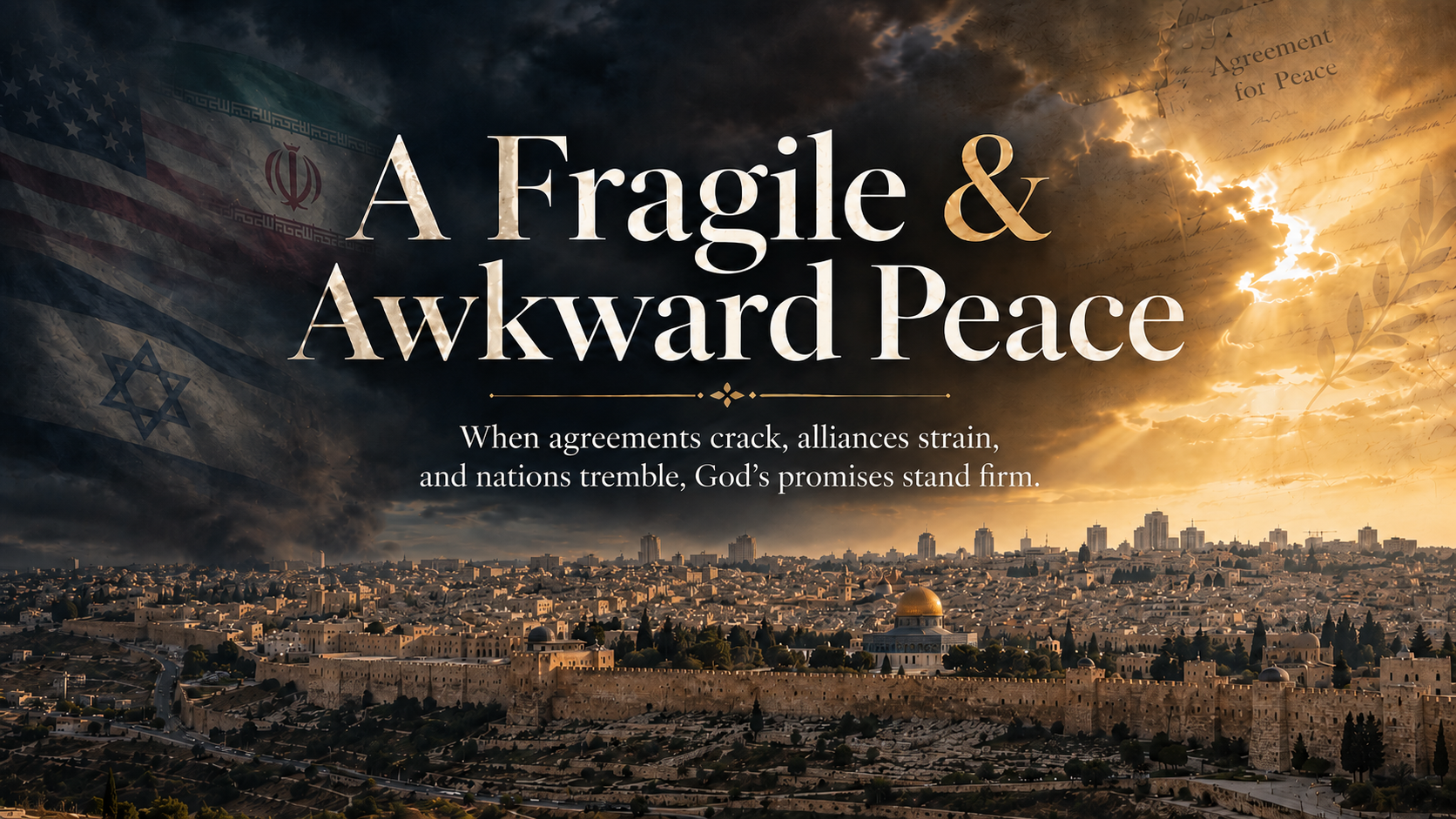
When agreements crack, alliances strain, and nations tremble, God’s promises stand firm.
Peace That Is Temporary
Over recent months, the fragility of peace in the Middle East has been impossible to miss. A war with Iran that many feared could widen even further appeared to come to an abrupt diplomatic pause with the signing of the Islamabad Memorandum of Understanding. The agreement was intended to halt open hostilities and provide a path toward further negotiations. Yet the renewed exchange of strikes between the United States and Iran has shown just how quickly a fragile peace can crack. What looked, for a moment, like diplomatic restraint now appears more like a temporary pause in a conflict still very much alive.
Of cause, most observers could plainly see that the deeper issues were never truly settled: Iran’s nuclear ambitions, its regional influence, the security of Israel, and the freedom of movement through the Strait of Hormuz all remained unresolved. The recent fracture has only exposed what was already true — peace built on pressure, political calculation, and unfinished agreements are awkwardly fragile.
Southern Lebanon Remains Unsettled
The same uncertainty is visible in southern Lebanon. While the fighting has eased, the region has not truly returned to peace. Israel continues to maintain a military presence in parts of southern Lebanon while the disarmament of Hezbollah and the restoration of Lebanese state control remain unresolved questions. For Israel, the concern is clear: Hezbollah’s military capacity and Iran’s reach through its proxies remain a direct threat. For Lebanon, the concern is sovereignty, displacement, and the long shadow of another unresolved conflict. In other words, the weapons may be quieter, but the tension has not disappeared.
One Thousand Days Since October 7
All of this is unfolding as Israel marked 1,000 days since the Hamas attack of October 7, 2023. That day shattered any illusion that Israel’s enemies had accepted its right to live in peace. The massacre, the hostages, the trauma, and the wars that followed have left deep wounds across Israeli society. One thousand days later, Israel is still grieving, still rebuilding, still arguing over what went wrong, and still trying to secure a future for its people.
At the same time, Gaza remains devastated and unresolved. The U.S.-led Board of Peace has promised a pathway toward stabilisation, reconstruction, and new governance, but rebuilding has stalled amid disputes over Hamas disarmament, questions of international authority, and continuing humanitarian need. For Israelis and Palestinians alike, the practical question is not only whether the fighting can stop, but whether anything lasting and objective can be rebuilt from the ruins.
Peace, when viewed through headlines alone, can feel terribly fragile.
Political Pressure in Washington and Jerusalem
There is also a striking political juxtaposition between President Trump and Prime Minister Netanyahu. Both men are trying to shape the next chapter of Israel’s security environment, yet both are doing so under the shadow of domestic political pressure. Netanyahu faces Israel’s expected election amid coalition instability, public division, unresolved questions over the war, and growing pressure from political rivals. Trump, while not personally on the ballot in the American midterms, faces a political test of his own. The outcome of the November congressional elections could either strengthen or weaken his mandate, especially after a costly and controversial confrontation with Iran.
Foreign Policy Is Never Made in a Vacuum
This matters because foreign policy is never made in a vacuum. Leaders may speak in the language of peace, security, deterrence, and national interest, but they are also conscious of elections, public opinion, coalition arithmetic, political legacy, and personal survival. Trump would like an Iran agreement to be seen as strength and deal-making success. Netanyahu needs to reassure Israelis that the sacrifices of the past 1,000 days have produced security, deterrence, and a viable path forward. In both cases, decisions about war, restraint, escalation, and diplomacy are tangled together with domestic political consequences.
A Divided Debate Over Military Service
Inside Israel, one of the sharpest examples of this tension is the question of compulsory military service for the Haredim. For decades, many ultra-Orthodox men have been exempt from military service while studying in yeshivas. But after October 7, with reservists serving repeated and exhausting tours of duty, the question has become deeply polarising. Many Israelis now ask how a nation at war can sustain unequal burdens of sacrifice. The High Court has ruled that the government must begin drafting Haredi men, while Haredi parties have threatened Netanyahu’s coalition if broad exemptions are not preserved. Israeli commentator Amit Segal has noted that Netanyahu’s long-standing partnership with the ultra-Orthodox parties is now under unusual strain. The issue has become more than a policy debate; it has become a test of national unity, fairness, and political survival.
Leaders Matter, But They Are Not Ultimate
None of this means every decision is cynical. Nor does it mean political leaders are unimportant. Scripture does not call believers to ignore rulers, elections, or the affairs of nations. We are told to pray for “kings and all who are in authority” so that people may live peaceful and quiet lives (1 Timothy 2:1–2). But Scripture also teaches us not to make rulers our refuge. “Do not trust in princes, in mortal man, in whom there is no salvation” (Psalm 146:3).
God’s Promises Stand Firm
That is the spiritual lesson beneath the politics. Allies may be helpful, but they are never ultimate. Leaders may be strong, but they are still limited. Agreements may restrain war, but they cannot heal the human heart. Coalitions may rise or fall, elections may shift, and public opinion may change. Yet the Lord does not change.
For those who love Israel and pray for the peace of Jerusalem, our confidence is not finally in Washington, Jerusalem, diplomacy, deterrence, or military strength. We pray for wise leaders. We pray for courage, justice, wisdom, and protection. But we remember that Israel’s ultimate security rests in the covenant-keeping God. “Behold, He who keeps Israel will neither slumber nor sleep” (Psalm 121:4).
When peace feels fragile, God’s promises stand firm.